
Why does an app ask me to scan my face before I can sign up?
Learn why apps ask to scan your face during signup. Understand the role of passive liveness detection in preventing fraud and ensuring you are a real, live user.
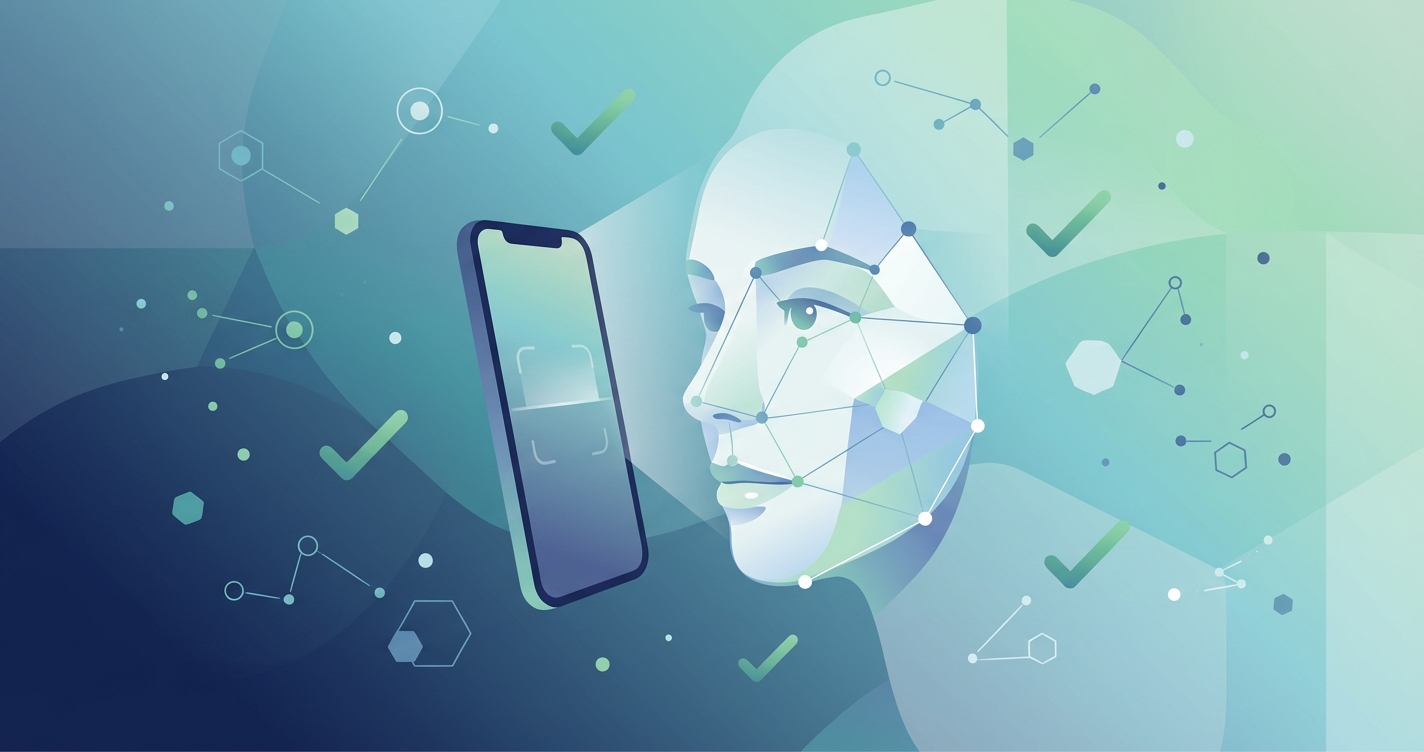
You are signing up for a new financial app or government service, and the process is going smoothly until you hit a wall: the app wants you to scan your face. For many, this is an unexpected and slightly unnerving step. It immediately raises questions about privacy, security, and necessity. Why do so many services now require this? The answer lies in the growing need for digital trust. As critical services move online, organizations must have a reliable way to confirm that you are who you say you are, and not an imposter using a stolen photo or a sophisticated deepfake. This article explains the technology behind these scans and why apps scan your face to sign up, focusing on the security measures that protect your identity.
"The global biometric identity verification market is projected to grow from USD 25.8 billion in 2024 to USD 60.5 billion by 2029, at a Compound Annual Growth Rate (CAGR) of 18.7%." - MarketsandMarkets (2024)
The core problem: presentation attacks
The fundamental reason why apps scan your face to sign up is to defend against something called a Presentation Attack. A presentation attack is an attempt to fool a biometric system by presenting it with a fake artifact, known as a Presentation Attack Instrument (PAI). In the context of face verification, this could be as simple as a printed photo of the victim or as complex as a high-resolution video or a digital deepfake.
Without a robust defense mechanism, a fraudster may:
- Use a photo or video of you from social media to open a bank account in your name.
- Wear a realistic mask to bypass a security check.
- Use a deepfake video in a live video call to impersonate you.
This is where liveness detection becomes critical. It is the technology that determines if the face presented to the camera is a real, live person. A simple image-matching check is not enough; the system must verify "liveness" to prevent fraud.
Comparing liveness detection methods
Not all liveness checks are the same. They are broadly categorized into "active" and "passive" methods, each with significant differences in user experience and security.
| Feature | Passive Liveness | Active Liveness | No Liveness Check |
|---|---|---|---|
| User Action | None required. The user simply looks at their camera. | Requires the user to perform an action (e.g., blink, smile, turn head). | User submits a static photo. |
| User Experience | Seamless and fast, leading to lower drop-off rates. | Can be cumbersome, confusing, and slow for the user. | Easiest for the user, but offers no security. |
| Security Level | High. Uses AI to analyze subtle physiological signals invisible to the naked eye. | Moderate. Can be defeated by some sophisticated video replays or masks. | None. Easily defeated by a printed photo. |
| Vulnerability | Low. More resilient to deepfakes and advanced presentation attacks. | Higher. The required actions can sometimes be spoofed. | Extremely high. Insecure for any meaningful transaction. |
Passive liveness detection represents the current current, offering strong security without adding friction to the user onboarding process.
Industry Applications
The need to verify a user's presence is not universal but is critical in regulated and high-stakes industries.
Financial services (finserv)
For banks, investment platforms, and fintech apps, strong identity verification is a regulatory mandate. Know Your Customer (KYC) and Anti-Money Laundering (AML) rules require firms to establish the identity of their clients. Using passive liveness detection during onboarding prevents fraudsters from creating accounts with stolen identities, a common vector for financial crime.
Government and public sector
Government agencies are increasingly offering digital access to sensitive services like tax portals, unemployment benefits, and DMV services. Verifying identity remotely is essential to prevent benefits fraud and ensure secure access to citizen data. The National Institute of Standards and Technology (NIST) provides detailed guidelines in its SP 800-63 series on how to implement robust remote identity proofing.
Healthcare
In the age of telehealth, confirming patient identity is critical for privacy and safety. A liveness check ensures that the person accessing medical records or receiving a remote consultation is the actual patient, protecting sensitive health information and preventing insurance fraud.
Current research and evidence
The field of Presentation Attack Detection (PAD) is an active area of research, driven by the constant evolution of spoofing techniques. The industry relies on standards and ongoing scientific inquiry to stay ahead of threats.
A key set of guidelines comes from the U.S. National Institute of Standards and Technology (NIST). NIST's Special Publication 800-63B, "Digital Identity Guidelines," outlines the technical requirements for federal agencies implementing digital identity services. It specifies the need for PAD to protect against presentation attacks.
In 2023, NIST released a comprehensive report, NISTIR 8500, titled "Biometric Presentation Attack Detection," which provides a deep survey of the current state of PAD technologies. This document acknowledges the rapid advancements in deep learning-based methods for detecting spoofs.
Academic research further propels the industry. For example, the 4th Face Anti-spoofing Workshop and Challenge, held in conjunction with the prestigious CVPR 2023 computer vision conference, brought researchers together to test their algorithms against new and challenging datasets. Such events are critical for benchmarking the performance of different PAD methods and driving innovation in the face of new threats like deepfakes. This body of research, from government standards bodies and academia, provides the foundation for the commercial systems that enterprises rely on.
The future of remote identity verification
The technology behind face-scan verification is continuously advancing. The future will likely see the rise of multi-modal systems that combine different biometric signals (e.g., face, voice, and behavioral patterns) to create an even more robust identity signal. Furthermore, expect an increased focus on privacy-enhancing technologies that allow for verification without requiring the service provider to store or even see the raw biometric data. As deepfake technology becomes more accessible, the AI that powers liveness detection will become even more sophisticated in response, analyzing more subtle and complex physiological data to distinguish between a real person and a synthetic fake.
Frequently asked questions
-
Is it safe to scan my face? Yes. Reputable applications do not store a photograph of your face. Instead, the scan is used for a one-time liveness check. For identity verification, the system creates a mathematical template of your facial features, not a stored image, to match against your ID document.
-
Can someone use a photo or video from my social media? This is precisely what liveness detection is designed to prevent. Passive liveness systems analyze subtle cues like light reflection, skin texture, and tiny involuntary motions that are absent in a photo or a simple video replay attack.
-
Why can't I just use a password and two-factor authentication (2FA)? Passwords and traditional 2FA can be compromised through phishing, malware, or database breaches. A liveness check proves physical presence here and now, providing a level of assurance that knowledge-based or token-based methods cannot match for initial identity proofing.
The brief moment an app takes to scan your face is a sophisticated security process designed to protect you. By confirming you are a real, live human at the point of signup, it blocks the primary method fraudsters use to create fake accounts and commit identity theft. As a CISO or identity platform provider, incorporating this technology is no longer optional. Circadify is at the forefront of developing passive liveness technology to address these challenges. To learn more about integrating robust fraud detection, see our Integration guide → circadify.com/solutions/fraud-detection.