Can I quickly prove who I am without having to go to an office?
How remote identity proofing easy enough for any smartphone lets people prove who they are in seconds, with passive liveness keeping verification fast and secure.
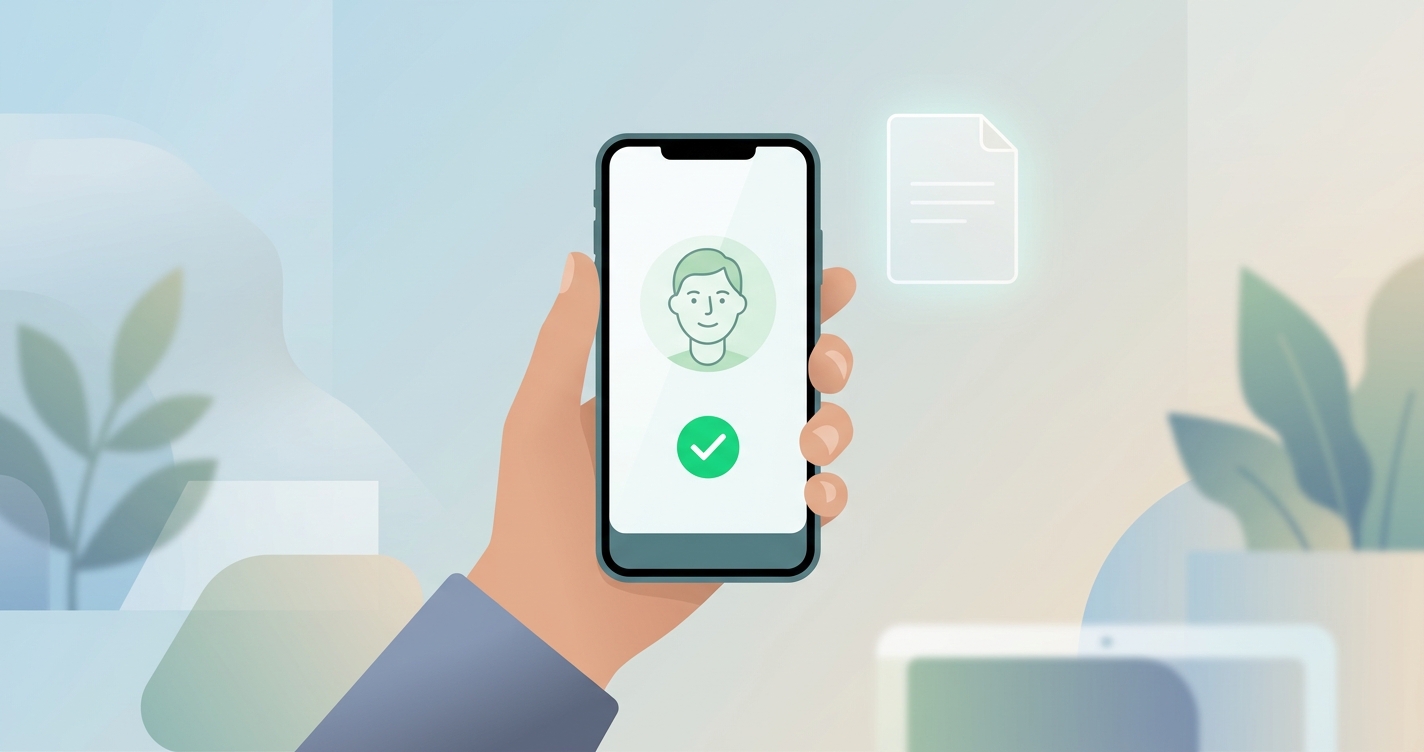
The expectation that proving your identity requires a trip to a branch, a counter, or a government office is quietly disappearing. People now open bank accounts on a train platform, enroll in benefits from a kitchen table, and renew credentials during a lunch break. Making remote identity proofing easy is no longer a nice-to-have feature for platform providers; it is the difference between a completed enrollment and an abandoned one. The technical question buried inside every "can I just do this from my phone?" is whether a system can confirm a real, present human and match them to a trusted document without forcing them through a maze of taps, retries, and awkward head movements.
Research by Signicat found that 68 percent of people have abandoned a digital onboarding process at least once, up from 40 percent in 2016, with friction and length cited as leading causes.
What makes remote identity proofing easy and trustworthy at the same time
Remote identity proofing is the process of establishing that a person is who they claim to be, conducted entirely over a network without an in-person agent. The National Institute of Standards and Technology codified this in its Digital Identity Guidelines, SP 800-63A. The fourth revision, finalized in July 2025, introduced a clearer taxonomy that separates Remote Unattended, Remote Attended, Onsite Attended, and Onsite Unattended proofing. The category that matters most for convenience is Remote Unattended: a fully automated flow with no human reviewer in the loop.
For that automated flow to be both easy and defensible, three things have to happen in a few seconds:
- The person captures a government-issued document and the system validates its authenticity.
- The system captures a live image of the person's face and matches it to the document portrait.
- The system confirms the face belongs to a living human physically present at capture, rather than a photo, video, mask, or synthetic deepfake.
That third step, liveness, is where convenience and security usually collide. Active methods ask users to blink, smile, turn their head, or follow a moving dot. Passive methods analyze the captured image and signal in the background without any instructions. The user simply looks at the camera. NIST Revision 4 also removed knowledge-based verification, the old "what was your previous address" approach, because it was both insecure and frustrating, which pushes the industry further toward biometric pathways that can be made genuinely fast.
| Proofing approach | User effort | Typical completion time | Fraud resistance | Best fit |
|---|---|---|---|---|
| In-office / branch visit | High (travel, queue, appointment) | Hours to days | High (human review) | Legacy high-assurance only |
| Remote attended (video call) | Medium (schedule, wait for agent) | 5 to 20 minutes | High | Edge cases, manual review |
| Remote unattended, active liveness | Medium (follow prompts, retries) | 1 to 3 minutes | Medium to high | General onboarding |
| Remote unattended, passive liveness | Low (look at camera once) | Seconds | High (with strong PAD) | High-volume, frictionless onboarding |
The pattern is clear. The closer a flow gets to "look at your camera once and you are done," the higher the completion rate, provided the underlying presentation attack detection is strong enough to hold the security line.
Why convenience is now a measurable business metric
Friction is expensive, and the numbers are blunt. Fenergo's 2025 research reported that 70 percent of financial institutions globally lost clients due to inefficient onboarding, up from 67 percent in 2024 and 48 percent in 2023. A Docusign study found that nearly 30 percent of users abandon an application when identity verification runs past six minutes. Most practitioners now target a one to three minute window for standard cases, and passive approaches push the verification step itself down to seconds.
The convenience case rests on a few consistent findings across the sector:
- Every additional action in a verification flow introduces a drop-off point where users quit.
- Retries triggered by failed prompts are a major source of abandonment, especially on older devices or in poor lighting.
- Accessibility matters. Active prompts that ask users to move or follow instructions can exclude people with motor or visual impairments.
- A flow that works on a standard smartphone camera, with no special hardware, reaches the widest possible population.
For government ID verification programs in particular, easy access is not just a conversion metric. It determines whether citizens can actually reach the services they are entitled to, which makes low-friction proofing a question of equity as much as efficiency.
Industry Applications
Government ID verification and public benefits
State agencies and national identity programs increasingly let residents prove who they are to access benefits, tax portals, and license renewals from home. The goal is a flow that a first-time user on an aging phone can finish without a help desk call. Passive liveness suits this audience because there is nothing to learn and nothing to perform; the user simply takes a selfie and a document photo.
Identity platform providers and eKYC
Platform providers selling verification as a service compete largely on completion rate and integration speed. Embedding passive liveness into an eKYC pipeline lets them advertise a single-step user experience while still meeting regulatory liveness requirements. Because the analysis runs on a normal camera frame, the same flow can serve banking, lending, and crypto customers without device-specific tuning.
Regulated remote onboarding
Banks, telehealth platforms, and gaming operators all share the same tension: regulators demand high assurance, while customers demand speed. A passive, document-plus-selfie flow gives compliance teams an auditable record and gives customers a verification step that feels like taking a photo rather than passing a test.
Current research and evidence
The evidence base now supports the claim that easy and secure are not opposing goals. NIST SP 800-63A Revision 4, finalized in July 2025, expanded its fraud-prevention guidance to address injection attacks and forged media such as deepfakes, signaling that automated remote proofing is expected to defend against synthetic threats rather than retreat from automation. The standard's new emphasis on usability, privacy, and equity alongside security reflects a recognition that overly burdensome proofing causes its own harms through exclusion.
On the conversion side, vendor case studies cited in industry reporting describe completion rates climbing from roughly 60 percent to above 95 percent after switching from active to passive liveness, attributing the gain to the removal of action prompts and retries. While those figures come from commercial deployments and should be read as directional rather than universal, they align with the independent abandonment research from Signicat and Fenergo. Presentation attack detection itself is measured against the ISO/IEC 30107-3 standard, which provides a common framework for testing how well a system rejects spoof artifacts, giving buyers a way to compare security without sacrificing the seamless user experience.
The technical frontier is signal-based liveness, including remote photoplethysmography (rPPG), which infers a pulse from subtle color changes in facial skin captured on video. Because it reads an involuntary biological signal, it can confirm presence without asking the user to do anything, which is precisely the property that keeps the flow easy.
The Future of remote identity proofing
The direction of travel is toward verification that becomes nearly invisible. Several shifts are likely to define the next few years:
- Deepfake-resistant liveness will move from a differentiator to a baseline expectation, as generative tools make static checks insufficient.
- Reusable and wallet-based digital identity credentials will let people prove themselves once and present that proof repeatedly, reducing repeat friction further.
- Standards bodies will continue tightening unattended IAL2 requirements, pushing automated flows to match the assurance of human review.
- Passive, hardware-agnostic methods will expand because they scale across the widest device base and the broadest population.
The endpoint is a world where proving who you are from anywhere is as ordinary as unlocking a phone, with the security work happening silently in the background.
Frequently asked questions
Can I really prove my identity without going to an office?
Yes. Remote identity proofing lets you confirm your identity entirely online by photographing a government document and capturing a selfie. Automated systems following frameworks such as NIST SP 800-63A can complete this in seconds without any in-person visit.
Why do some checks feel instant while others make me move my head?
The difference is active versus passive liveness. Active liveness asks you to blink or turn your head to prove you are real. Passive liveness confirms a living, present human from a single normal image or short video, which is why it feels effortless.
Is a fast, easy verification less secure?
Not inherently. Speed comes from removing user actions, not from skipping security. Strong passive systems run presentation attack detection measured against ISO/IEC 30107-3 in the background, so the security check happens without adding steps for the user.
What equipment do I need to prove my identity remotely?
In most cases, just a standard smartphone with a camera. Passive, hardware-agnostic liveness is designed to work without special sensors, which is what makes remote proofing accessible to nearly everyone.
Circadify is building toward this exact problem space, developing passive liveness that verifies a real, present human from an ordinary camera frame without asking anyone to blink, turn, or perform. For identity platforms and government programs that want to make remote identity proofing both easy and defensible, our integration guide walks through how passive liveness fits into an existing verification flow.