
5 Identity Verification Architecture Patterns for Multi-Cloud Enterprises
A research-style report for CISOs on architectural patterns for managing identity and access in complex, multi-cloud enterprise environments.
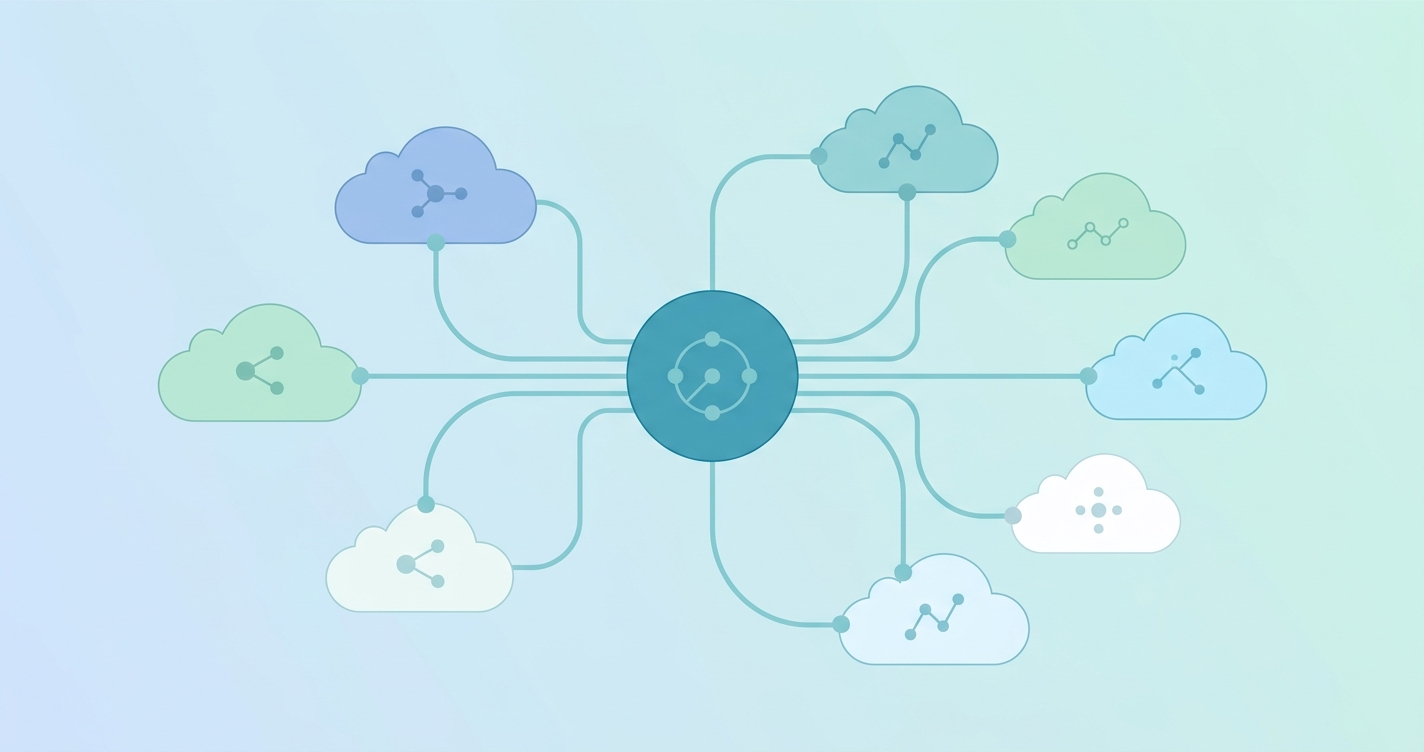
The migration to multi-cloud environments is a defining feature of the modern enterprise technology stack. Organizations adopt multi-cloud strategies to optimize for cost, performance, and feature availability, using "best-of-breed" services from providers like AWS, Azure, and Google Cloud. However, this distributed infrastructure creates significant hurdles for identity and access management (IAM). Without a deliberate identity verification architecture for the multi-cloud enterprise, organizations face a fragmented landscape of identity silos, inconsistent security policies, and an expanded attack surface, undermining the very benefits the cloud promises.
"By 2029, more than 50% of organizations will fail to realize the expected benefits of their multi-cloud deployments because of an inability to overcome interoperability and operational complexity."
- Gartner, Inc.
The challenge of a multi-cloud identity verification architecture
The core challenge stems from the lack of a universal identity standard across cloud platforms. Each provider has a proprietary IAM system (e.g., AWS IAM, Azure Active Directory, Google Cloud IAM) with unique constructs for users, roles, and permissions. For a multi-cloud enterprise, this results in "identity sprawl," where user identities are duplicated and managed independently in each environment. This Increases administrative overhead. Introduces critical security risks. An employee offboarded from one system may retain access to another, and applying a consistent, least-privilege access policy across all clouds becomes a manual and error-prone process. A cohesive identity verification architecture for a multi-cloud enterprise seeks to unify control, streamline governance, and ensure a consistent security posture, regardless of where data and applications reside. These architectures are not just about authentication but also about providing the robust verification needed to meet modern security and compliance demands.
| Pattern | Centralization | Complexity | Interoperability | Security Control |
|---|---|---|---|---|
| Federated Identity | High | Medium | High (Standards-based) | Centralized |
| Identity Broker | High | High | Very High (Abstracts protocols) | Centralized & Granular |
| Hub-and-Spoke | High | Medium | Medium | Centralized Policies |
| Centralized Database | High | Low | Low (Requires sync) | Centralized |
| Decentralized (Multi-IdP) | Low | Very High | Low (Point-to-point) | Fragmented |
1. federated identity model
The Federated Identity pattern is one of the most common and mature approaches. It uses a single, trusted Identity Provider (IdP) to manage authentications for all connected cloud environments, known as Service Providers (SPs).
- How it works: When a user tries to access a service in any cloud, the SP redirects the authentication request to the central IdP. The user authenticates once with the IdP, which then passes a security assertion (using standards like SAML 2.0 or OIDC) back to the SP, granting access.
- Advantages: Simplifies user experience with single sign-on (SSO), centralizes authentication policies, and improves security by consolidating identity management.
- Considerations: Requires all service providers to support federation standards. The central IdP becomes a critical component; its availability is critical.
2. identity broker model
The Identity Broker pattern builds on federation by introducing an intermediary service that decouples service providers from specific identity providers. This is a highly flexible identity verification architecture for a multi-cloud enterprise.
- How it works: The broker acts as a central hub. Applications connect to the broker, and the broker connects to one or more IdPs. This allows enterprises to use different IdPs (e.g., Azure AD for corporate users, a social IdP for customers) and have them all work with any application. The broker handles protocol translation between different identity standards.
- Advantages: Maximum flexibility and interoperability. It can abstract the differences between cloud IAM systems, providing a single point of integration and policy enforcement.
- Considerations: Introduces an additional layer of complexity and a potential performance bottleneck. The broker itself must be highly available and secure.
3. hub-and-spoke model
This architecture uses a central "hub" environment to manage identity and access policies, which are then pushed out to the "spoke" cloud environments.
- How it works: A central IAM platform, often hosted in one of the primary clouds or on-premises, serves as the source of truth for identities and roles. Scripts or automation tools then provision and synchronize these identities and policies to the native IAM systems of the other cloud providers.
- Advantages: Allows for centralized policy management while still using the native, fine-grained access controls within each cloud. It's a practical balance for organizations deeply invested in specific cloud ecosystems.
- Considerations: The automation and synchronization logic can become complex to maintain, especially as the number of clouds and the granularity of permissions grow.
4. centralized identity database with synchronization
This is a more direct approach where a master identity database (like an on-premises Active Directory or a cloud directory) synchronizes user data directly to each cloud provider's directory.
- How it works: Tools like Azure AD Connect or custom scripts are used to push user objects, attributes, and sometimes even password hashes to each cloud environment. This is not federation; it creates native objects in each cloud.
- Advantages: Conceptually simple and ensures identities are present as native objects in each cloud, which can be a requirement for some applications and services.
- Considerations: Leads to identity duplication and can be less secure if password hashes are synchronized. It does not centralize authentication in real-time, creating potential for synchronization lag.
5. Decentralized (Multi-IdP) Model
In this model, an organization chooses to manage identities separately within each cloud provider, essentially accepting and managing the identity silos.
- How it works: Administrators manage users and permissions directly within AWS IAM, Azure AD, and Google Cloud IAM. There is no central point of control.
- Advantages: Maximally uses the native capabilities of each platform and avoids the complexity of building a unified architecture. This might be suitable for highly decentralized organizations where business units have full autonomy.
- Considerations: This pattern significantly increases the risk of inconsistent policies, orphaned access, and compliance gaps. It is generally considered an anti-pattern for enterprises seeking strong security and governance.
Current research and evidence
The challenges of multi-cloud identity are well-documented by industry analysts. Research from Gartner, Inc. highlights that managing IAM in a multi-cloud environment is a top concern for security and risk management leaders. Their analysis highlights the trend toward using external identity providers and Cloud Infrastructure Entitlement Management (CIEM) tools to gain visibility and control over complex permissions. A 2023 report from the research firm Enterprise Strategy Group (ESG) noted that 71% of organizations have experienced a security incident related to overly permissive cloud access, reinforcing the need for a robust architectural approach. The consensus in the research community is that manual management is no longer viable and that automated, policy-driven architectures are essential for security at scale.
The future of identity in multi-cloud
The future of multi-cloud identity architecture is moving towards a Zero Trust model. This means abandoning the idea of a trusted internal network and instead verifying every access request, regardless of its origin. For identity, this translates to continuous authentication and authorization, often incorporating risk signals like user behavior, device posture, and location. Biometric verification, particularly passive liveness detection, is becoming a key enabler for this model. It provides a frictionless way to re-verify a user's presence during a session without interrupting their workflow, offering a higher level of assurance than passwords or one-time codes alone. As organizations build their next-generation identity verification architecture for a multi-cloud enterprise, incorporating such continuous, passive verification will be critical for securing access against sophisticated threats.
Frequently asked questions
What is the most common identity architecture for multi-cloud environments? The Federated Identity model using a central Identity Provider (IdP) like Azure AD or Okta is the most common starting point for enterprises. It provides a good balance of centralized control and user convenience through single sign-on (SSO).
How does Zero Trust impact multi-cloud identity architecture? Zero Trust principles require the architecture to support continuous verification. The identity system can no longer grant access based on a one-time login. It must be able to challenge for re-authentication or use signals like biometrics to continuously validate the user's presence and context throughout a session.
What are the first steps to creating a multi-cloud identity strategy? The first step is discovery and inventory. Organizations must identify all the cloud services in use (sanctioned and unsanctioned) and map out where all user identities currently reside. This visibility is the foundation for designing a unified architecture.
As enterprises architect their identity infrastructure for this new reality, solutions that provide strong, frictionless identity verification become critical components. Circadify is at the forefront of addressing this space, developing technologies that enable passive liveness detection to support continuous, secure authentication across complex environments. To learn more about integrating advanced fraud detection capabilities, see our integration guide at circadify.com/solutions/fraud-detection.